Professor Guillaume Marois and Distinguished Professor Wolfgang Lutz, from the Institute of Demography and the Asian Demographic Research Institute (ADRI) at the Department of Sociology, Shanghai University, published their latest research findings titled “Low fertility may persist and could be good for the economy” in the top-tier international academic journal Nature Human Behaviour on March 2, 2026. Prof. Lutz served as the corresponding author, with Shanghai University listed as the corresponding institution. This marks another significant breakthrough for the Asian Demographic Research Institute in publishing in a top-tier international journal.
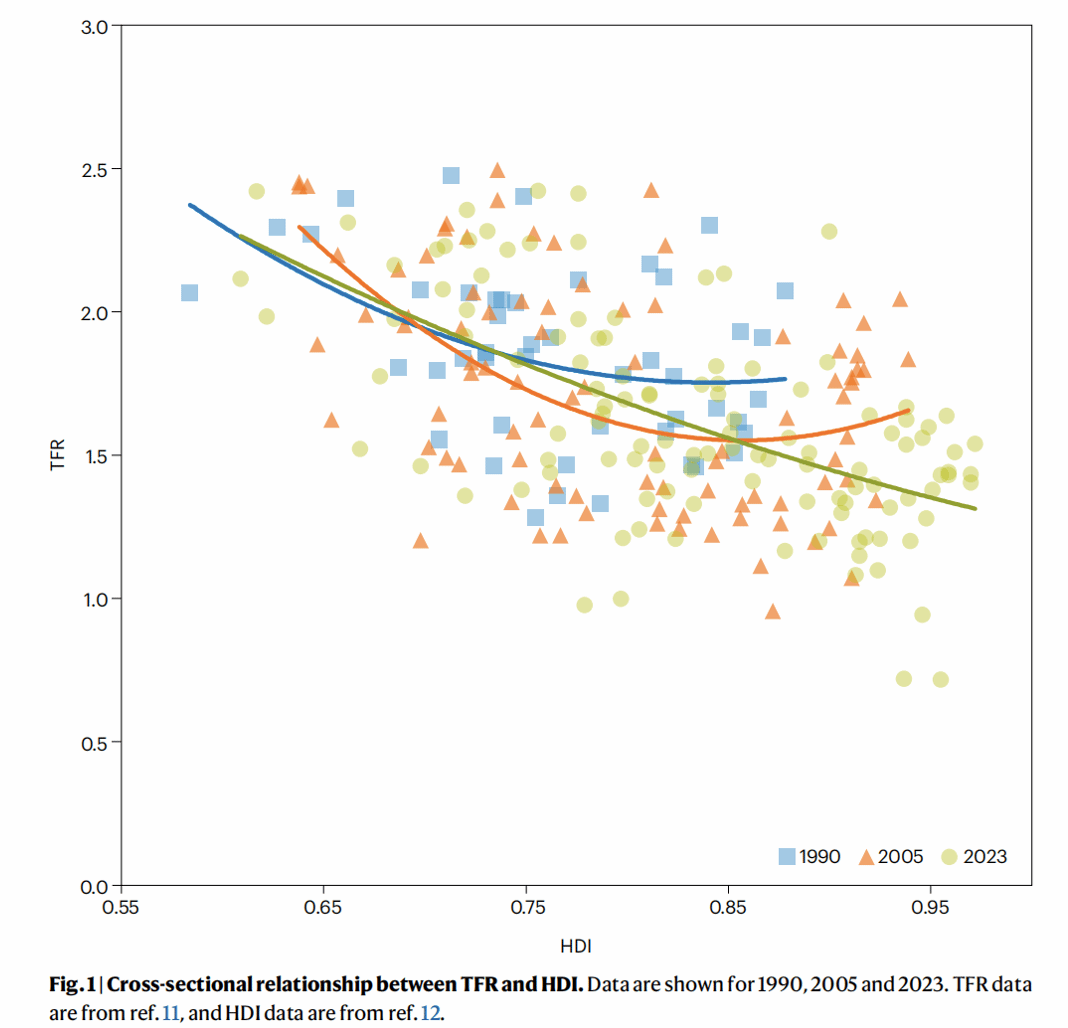
For a long time, total fertility rates far below 2.1 have been viewed as a major concern in high-income countries. Analyzing the latest data from 2023, the study found that as the Human Development Index (HDI) rises, fertility rates do not rebound but instead exhibit a clear negative correlation, suggesting that low fertility may persist in developed economies over the long term. The study emphasizes that the key determinants of social well-being are not total population size, but rather population structure and education-driven labor productivity. At lower fertility levels, families and governments can increase educational investment per child; this improvement in human capital quality, combined with the effects of capital deepening, can effectively compensate for the decline in the working-age population. Model simulations show that, when accounting for intergenerational transfers and technological progress, the optimal fertility rate that maximizes per capita consumption is typically far below the replacement level (i.e., a total fertility rate of 2.1), often at 1.5 or even lower. Therefore, policymakers should not blindly pursue a rebound in fertility rates but should shift their strategic focus toward improving population quality and fostering technological innovation to address the long-term challenges posed by demographic transition.
Since its establishment, the Center for Asian Population Studies at Shanghai University has been committed to international and interdisciplinary teaching and scientific research. It has published a series of high-quality research findings in the fields of population, society, environment, economy, and health, with over 50 papers published as first or corresponding author in core journals such as SCI, SSCI, and CSSCI in the past three years.
Full article can be found in: https://doi.org/10.1038/s41562-026-02423-6