Professor Leiwen Jiang of the Asian Demographic Research Institute (ADRI) at Shanghai University, published his latest research findings along with the research team in the Proceedings of the National Academy of Sciences (PNAS) on October 26, 2026, titled "Equity dimensions of future vulnerabilities to climate hazards: Long-term spatial population projections for New York City consistent with Shared Socioeconomic Pathways". Prof. Jiang serves as the corresponding author of the paper, and ADRI is the corresponding author's institution. This marks the eighth PNAS publications by researchers affiliated with ADRI.
The study addresses a critical challenge in climate change research: translating global socioeconomic and climate scenarios into detailed, locally relevant population projections that can support cities to meet climate challenges.
As climate change intensifies, cities face growing risks from extreme heat, flooding, sea-level rise, and other environmental hazards. However, climate risks depend not only on the changing physical environment but also on how urban populations evolve—where people live, how old they are, and how their socioeconomic and demographic characteristics differ. Developing city-specific population scenarios consistent with broader climate and socioeconomic pathways is therefore essential for understanding future urban vulnerabilities and designing effective, equitable strategies to adapt and mitigate climate challenges.
A major methodological contribution of the research is its integration of multidimensional and multiregional demographic projections with fine-scale spatial modeling. Building on the multiregional modeling framework of the Community Demographic Model (CDM) developed by Professor Jiang, the research team extended the approach to incorporate racial and ethnic characteristics alongside age and sex, while explicitly accounting for demographic interactions among New York City's five boroughs, the rest of the United States, and the international population system. Another important innovation is the explicit incorporation of racial and ethnic diversity into long-term urban population projections, providing a demographic foundation for examining inequality in future climate vulnerabilities. Migration emerges as a particularly important determinant of future population size, composition, and spatial distribution, highlighting the need to incorporate migration explicitly into long-term urban scenario development.
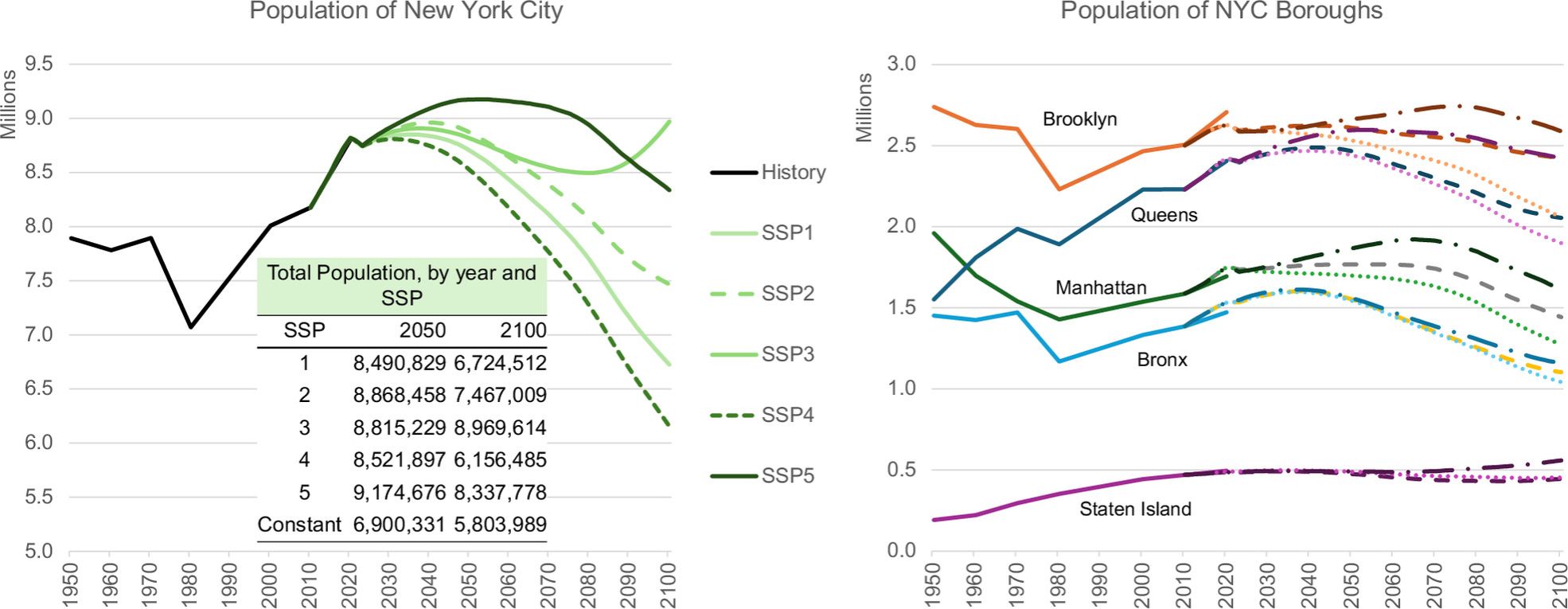
The high-resolution projections further illustrate how alternative socioeconomic pathways can lead to different urban settlement patterns and racial and ethnic distributions. These differences demonstrate that future climate vulnerability cannot be adequately understood from citywide population totals alone; it also requires attention to the spatial and demographic dimensions of inequality.
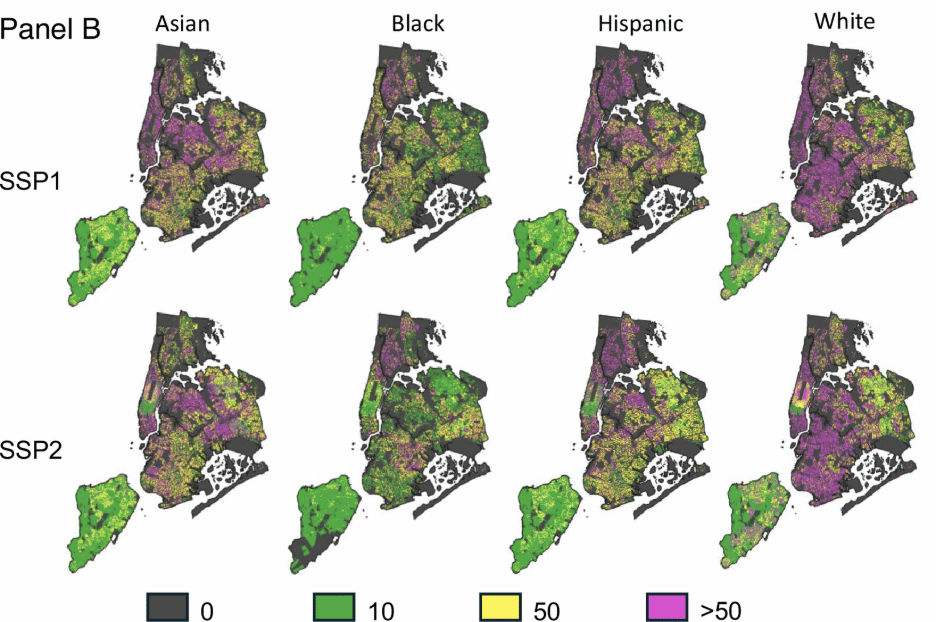
The study represents an important advancement in linking demographic science with climate change research and urban sustainability planning. By extending the CDM's multiregional demographic modeling approach to a multidimensional, city-specific framework, the research provides a transferable methodological foundation for developing locally relevant population scenarios that remain consistent with broader global socioeconomic pathways. When combined with spatially detailed climate-hazard information, these projections can support more comprehensive assessments of future exposure, vulnerability, and adaptation needs across different population groups.
Beyond New York City, the approach offers valuable insights for other large, socially diverse cities confronting the combined challenges of climate change, demographic transition, migration, and inequality, especially in Asia. It demonstrates how advances in demographic modeling can contribute to climate justice, inclusive urban development, and evidence-based adaptation policies, ensuring that the needs of vulnerable and historically disadvantaged communities receive greater attention in long-term planning.
The research reflects ADRI's continued commitment to interdisciplinary and internationally collaborative research at the intersection of population dynamics, climate change, sustainable development.
Full text link of PNAS: https://doi.org/10.1073/pnas.2407568122
Published in PNAS, Volume 123, Issue 44 (2026), Article e2407568122.